
Repair explainer · 5 min read
Hard water and a Sub-Zero ice maker: cloudy cubes and slow ice in Lamorinda
Cloudy, small or slow ice from a Sub-Zero in Lafayette usually starts with hard inland water fouling the inlet valve, mold and filter. What hardness does to an ice maker, the filter cadence, and when scale becomes a service call.
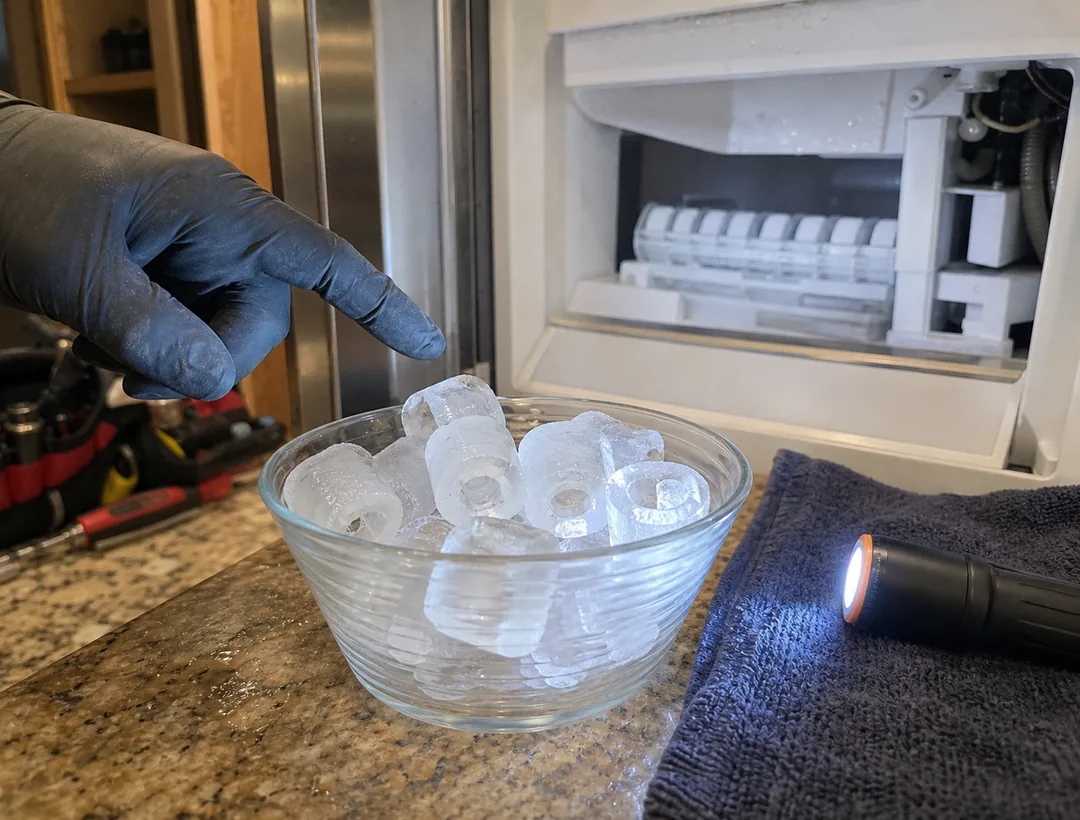
A Sub-Zero ice maker is supposed to be the part of the kitchen you never think about, so when the cubes turn cloudy, shrink, taste faintly mineral, or simply slow to a trickle, it is genuinely annoying. In Lafayette and across Lamorinda, the first suspect is almost always the same: the hard inland water feeding the unit. Before anyone replaces an ice-maker module, it is worth understanding what water hardness does inside these machines, because the cheapest fixes — a fresh filter, a descaled valve — solve a surprising share of the calls.
This explainer covers how mineral content fouls the water path, the symptoms a collector of good ice will notice first, the filter cadence that actually keeps up with our water, and the point at which scale stops being maintenance and becomes a repair.
What hardness does to the water path
An ice maker is a small water system: a supply line feeds an inlet valve, the valve meters water into a filter and then into the mold or evaporator plate, and a harvest cycle drops the finished cubes into the bin. Every one of those stages is sensitive to mineral content. On the hard water that reaches 94549 kitchens, dissolved calcium and magnesium plate out as scale on the valve seat, in the fill tube, and across the mold, exactly the way a kettle furs up over time.
That scale has three effects. It restricts flow, so the mold fills with less water and the cubes come out small. It clouds the ice, because the minerals that would normally stay dissolved get trapped as the water freezes. And it slows the whole cycle, because a partly scaled valve meters water more slowly and a scaled plate releases its harvest less cleanly. None of it means the ice maker has failed — it means the water has been working on it.
The symptoms you notice first
Owners usually report the same short list. Cubes get cloudy or white-cored instead of clear. They shrink, or come out hollow and break easily. The ice picks up a faint mineral or stale taste, especially if the filter is overdue. And output drops — a bin that used to refill overnight takes a day, or the unit seems to skip cycles. In a Lafayette household that entertains, that slowdown tends to surface right before a gathering, which is when the call comes in.
The useful thing about these symptoms is that they are progressive. Hard-water fouling comes on gradually, so a sudden total stop is more likely a frozen fill tube, a failed inlet valve or a control fault than scale alone. Telling us whether the decline was slow or abrupt helps point the diagnosis before we arrive.
Filter cadence that keeps up with our water
The single most effective habit for ice quality on this side of the Caldecott is staying ahead of the water filter. Sub-Zero's roughly annual filter interval is written for average water; on the harder inland supply many Lamorinda homes actually do better changing it more often, because a spent filter stops protecting the valve and mold and lets scale accelerate. If your ice has turned cloudy and you cannot remember the last filter change, that is the first and cheapest thing to correct.
Beyond the filter, running the ice maker regularly rather than letting it sit, and discarding the first batch after a long vacation, both help. But filters and use habits only hold the line; they do not reverse scale that has already built up on the valve and mold, which is where service comes in.
When scale becomes a service call
Maintenance has limits. Once mineral scale has built up on the inlet valve seat or hardened across the mold, a new filter will not bring clear, full-size cubes back on its own — the valve needs descaling or replacing and the mold or evaporator plate needs proper attention. The same is true if the fill tube has frozen, the valve has failed outright, or output has stopped rather than just slowed. Those are diagnosis-and-repair jobs, not filter changes.
We separate water-quality problems from mechanical ones by checking flow, valve operation, filter age and cube quality together, so you are not paying to replace a module when a descaled valve and a fresh filter would do. Every visit opens with an $89 diagnostic that applies to the repair, with a 365-day warranty on the work. We are an independent repair company, not factory-authorized; book directly at (925) 940-3576.
FAQ
Questions & answers
Why is my Sub-Zero ice cloudy and small in Lafayette?
Hard inland water is the usual cause. Dissolved minerals scale the inlet valve, fill tube and mold, which restricts flow so cubes come out small and traps minerals so they freeze cloudy. A fresh filter and, if scale has built up, a descaled or replaced valve restore clear, full-size ice.
How often should I change the water filter on Lamorinda's hard water?
Sub-Zero's roughly annual interval is a baseline for average water; on the harder inland supply here, changing it somewhat more often pays off because a spent filter stops protecting the valve and mold and lets scale accelerate. If your ice has gone cloudy and the filter is overdue, start there.
My ice maker stopped completely — is that hard water too?
A sudden full stop is less likely to be scale, which comes on gradually, and more likely a frozen fill tube, a failed inlet valve or a control fault. Tell us whether the decline was slow or abrupt; our ice-maker and water-line page walks the valve, fill tube and filter, and we confirm the cause before quoting.
Go deeper
More Lafayette guides
Does That Sub-Zero Repair Company Really Cover Lafayette? A Lamorinda Coverage Check
Three tests that prove a Sub-Zero repair company really covers Lamorinda: today's start point, drive time from the listed address, and Highway 24 fees.
Read the guide → Dual refrigeration · 4 minSub-Zero Dual Refrigeration Explained: Why One Side Warms
Sub-Zero uses two independent sealed systems for fridge and freezer. Why one side warms while the other stays cold, and what repair really costs in Lafayette.
Read the guide → Repair vs replace · 5 minThe Repair-or-Replace Math for an Aging Sub-Zero in Lafayette
Run the numbers on an aging Sub-Zero in Lafayette: repair cost bands by age bracket, the real 94549 replacement total, and the 50 percent rule worked out.
Read the guide →Rather leave it to a specialist?
Have the failing compartment and model number ready, and you will get a real first opinion — not a sales pitch.