
Sub-Zero guide · 6 min read
Sub-Zero Wine Cooler Repair in Lafayette: reading the faults a collector feels first
A Sub-Zero wine cooler in a Lafayette cellar guards a real investment. The faults we diagnose most — dual-zone sensor drift, sealed-system loss, vibration and seals — and when repair beats replacement.
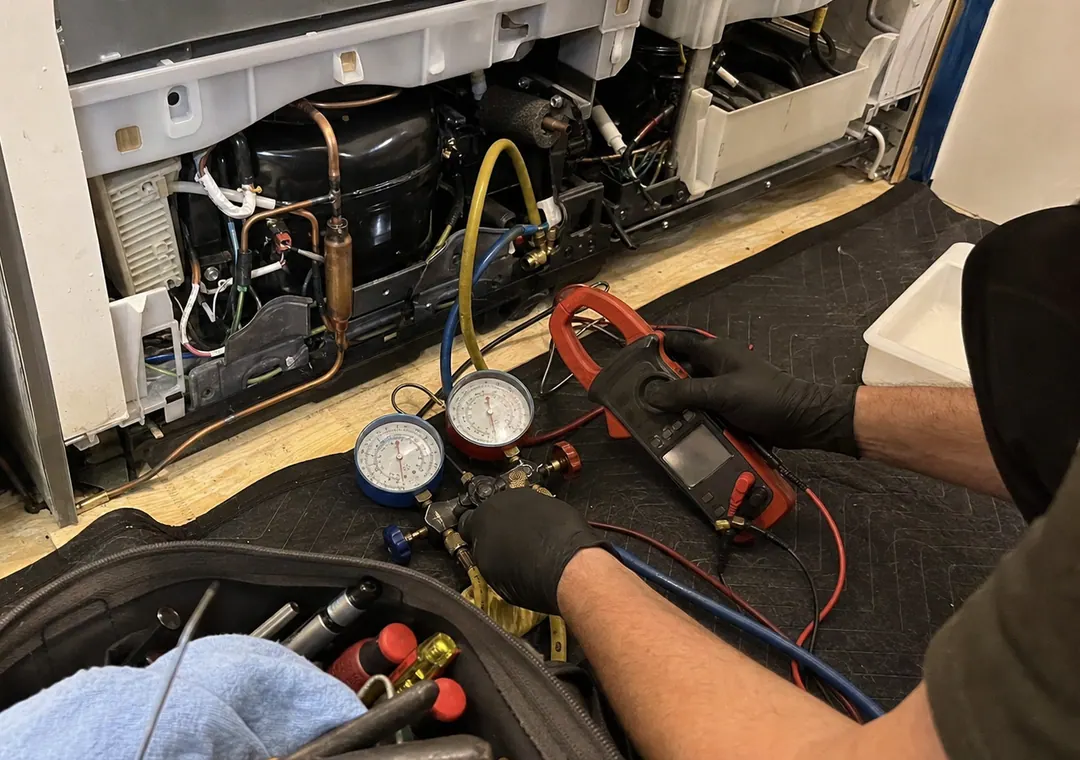
When a Lafayette homeowner calls about a Sub-Zero wine cooler, the symptom is rarely a hard failure. It is a feeling: the Pinot that always tasted right now reads a touch warm, or the bottom of a tall column has crept a few degrees away from the top. Built-in wine storage is the most temperature-sensitive thing Sub-Zero makes, and a collection assembled over years of trips to the nearby Livermore and Napa valleys is worth protecting properly.
This is a repair-side guide. Instead of general tips, it walks the actual faults we trace on these units in Lafayette homes — from Happy Valley estate cellars to the converted wet-bar columns common along Mt. Diablo Boulevard — and where the line between a worthwhile fix and a replacement really falls.
Dual-zone sensor drift is the fault you taste before you see
Most Sub-Zero wine units run two independent zones, each with its own thermistor reporting cabinet temperature back to the control. When one of those sensors drifts out of calibration, the control happily holds a number that is no longer true — the display says 55, the bottle says 60. We diagnose this by measuring the resistance of each sensor against Sub-Zero's spec and logging real zone temperatures over a cycle, rather than trusting the panel. A single out-of-spec thermistor is an inexpensive, common repair, and catching it early is what separates a quick part swap from a season of slow heat damage to a stored collection.
Sealed-system and airflow faults: where the cold actually goes
A wine cooler makes cold the same way a refrigerator does — a compressor drives refrigerant through a sealed loop, an evaporator pulls heat out of the cabinet, and an evaporator fan moves that chill across the racks. When a unit cannot reach temperature at all, we work outward from the cheap and common toward the rare and costly: a condenser furred with dust in the dry inland air around Reliez Valley, a stalled evaporator fan, a frosted coil, and only last a genuine sealed-system refrigerant loss. That order matters. Many Lafayette wine units that 'won't get cold' simply have a loaded condenser and a tired fan, and chasing the compressor first would cost a customer dearly for nothing.
Seals, UV glass, and the vibration a collector should care about
Two faults specific to wine storage get overlooked. The first is the door — a stretched gasket or a sagging hinge on a heavy UV-tinted glass door lets warm room air leak in along the seam, and in a west-facing Lafayette great room the solar gain through that glass already pushes the unit hard. The second is vibration. A compressor mount or fan bearing that has begun to buzz transmits a faint, constant tremor into the racks, and over time that disturbs the sediment in aging reds — the kind of slow harm a serious collector notices long before any gauge does. We check both, because on a wine column the quiet problems are often the expensive ones.
Repair or replace: how we draw the line
Sub-Zero built these units to be serviced, and on a built-in column installed into Lafayette cabinetry the economics almost always favor repair: sensors, fans, gaskets, control boards, and even sealed-system work are well-trodden jobs, and replacing the unit means re-fitting a panel-ready enclosure that was scribed to the kitchen. We recommend replacement only when an older cabinet stacks a failed sealed system on top of corroded internals — a genuinely uncommon verdict. Every visit opens with an $89 diagnostic that applies to the repair, and our work carries a 365-day warranty on parts and labor. We are an independent service, not factory-authorized, which simply means you book us directly — call (925) 940-3576 or use online booking.
FAQ
Questions & answers
My Sub-Zero wine cooler shows the right temperature but the wine feels warm — what's wrong?
That gap between the display and reality is the classic sign of a drifting zone sensor. The thermistor reporting to the control has gone out of spec, so the unit holds a number that is no longer accurate. We confirm it by measuring sensor resistance and logging actual cabinet temperature, and a single sensor is usually an inexpensive fix.
Is a Sub-Zero wine cooler worth repairing, or should I replace it?
On a built-in column repair almost always wins. The common faults — sensors, fans, gaskets, control boards — are straightforward, and replacing means re-fitting a panel-ready unit into cabinetry built around it. We only advise replacement when an old cabinet combines a failed sealed system with corroded internals, which is rare.
Do you service wine coolers, and is this Sub-Zero or Wolf?
Wine and beverage columns are Sub-Zero — Wolf makes only cooking equipment. We service Sub-Zero wine storage across Lafayette and the Lamorinda area on our regular Highway 24 route. Book at (925) 940-3576 or online; we are an independent repair company, not factory-authorized.
Go deeper
More Lafayette guides
Does That Sub-Zero Repair Company Really Cover Lafayette? A Lamorinda Coverage Check
Three tests that prove a Sub-Zero repair company really covers Lamorinda: today's start point, drive time from the listed address, and Highway 24 fees.
Read the guide → Dual refrigeration · 4 minSub-Zero Dual Refrigeration Explained: Why One Side Warms
Sub-Zero uses two independent sealed systems for fridge and freezer. Why one side warms while the other stays cold, and what repair really costs in Lafayette.
Read the guide → Repair vs replace · 5 minThe Repair-or-Replace Math for an Aging Sub-Zero in Lafayette
Run the numbers on an aging Sub-Zero in Lafayette: repair cost bands by age bracket, the real 94549 replacement total, and the 50 percent rule worked out.
Read the guide →Rather leave it to a specialist?
Have the failing compartment and model number ready, and you will get a real first opinion — not a sales pitch.